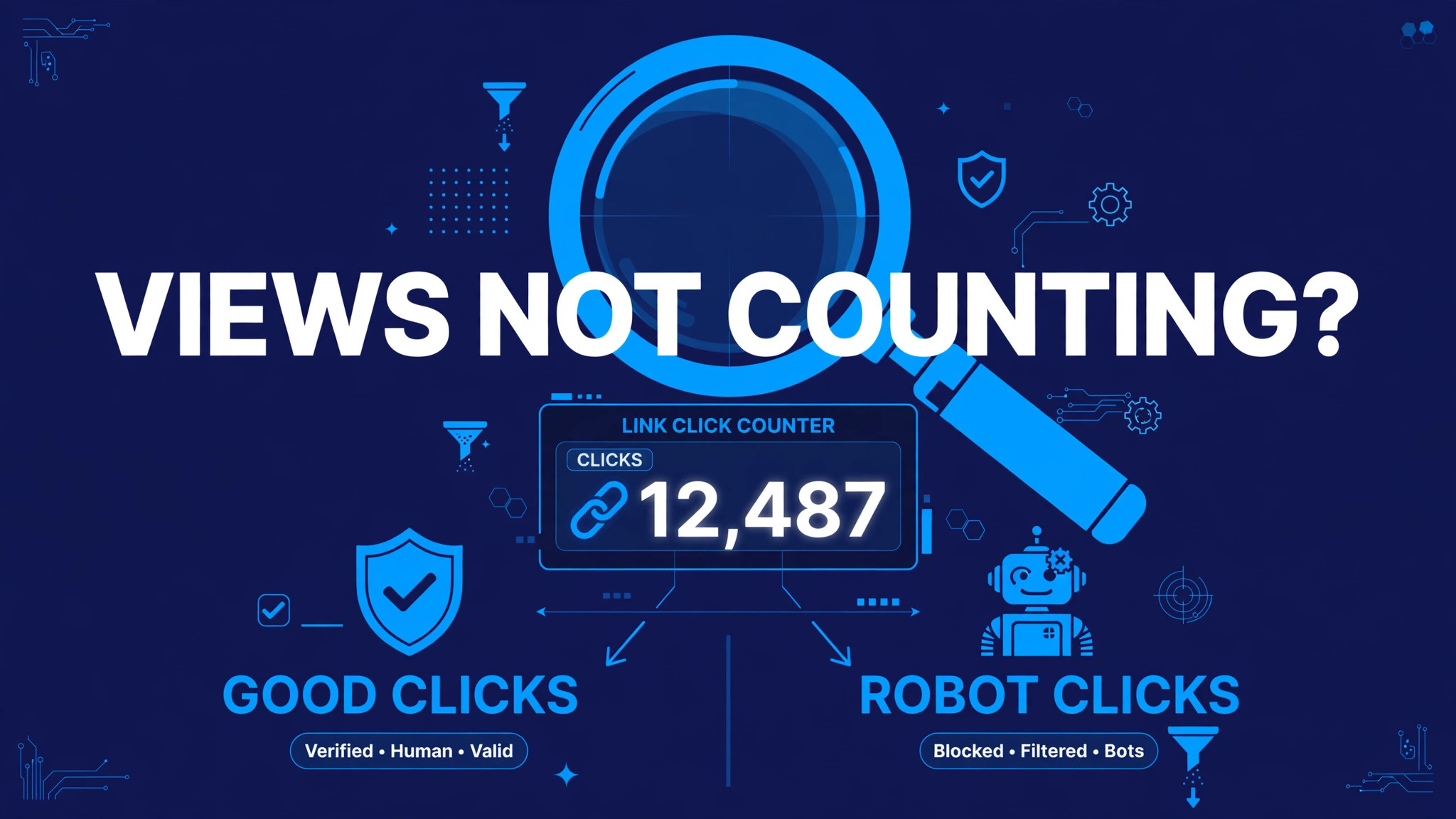
Your link got 1,000 clicks, but your balance only moved for about 600 of them. Frustrating — and on most shorteners, a total mystery. On Shortun it never has to be: every filtered view carries a reason, shown right in your link statistics. This guide explains all nine filters, why they exist, and how to raise the share of views that actually pay you.
How counting works, in 20 seconds
When someone opens your short link, Shortun checks the visit before crediting it: is it a real person, in a valid country, seeing the advertising page properly, for the first time in a while? If yes, the view is counted and you earn. If not, it is filtered with a reason. Advertisers pay for real human attention — the filters are what keeps your rates worth having.
The 9 filters, explained
| Filter reason | What it means | How to reduce it |
|---|---|---|
| Not unique | The same visitor opened the link again within the uniqueness window | Normal for popular links; grow reach instead of repeat clicks |
| Adblock | The visitor's ad blocker prevented the ad page from loading | Ask your audience to whitelist; audiences on mobile apps block less |
| Proxy / VPN | The visit came through a proxy, VPN or data-centre IP | Nothing to fix — this traffic is filtered to protect advertisers |
| Cookies disabled | The browser refused cookies, so the visit could not be verified | Mostly older or locked-down browsers; a small share everywhere |
| Direct visit | The link was opened with no referrer and no session (often bots or preview crawlers) | Share links inside real posts and pages, not bare in crawlers' reach |
| Invalid country | The visitor's country is not one advertisers buy | Audience targeting: content for US/UK/CA audiences counts at top rates |
| Earnings disabled | The link or account has monetisation off | Check the link's settings in your dashboard |
| Blocked referer | The traffic came from a source on the blocklist (spam/abuse sources) | Keep links off spam directories and auto-posting bots |
| Rate limit | Too many visits from one source in a short burst | Spread posts out; bursts from a single IP look automated |
What is a healthy counted ratio?
For genuinely shared links, 75–90% of views counting is normal. The biggest everyday losses are repeat visits and adblock — both are facts of life on the open web. If your counted share is far below that, the table above usually points at the cause: a burst-posting pattern, a proxy-heavy traffic source, or an audience in countries advertisers do not buy.
How to check any of your links
Open the link's statistics from your dashboard (Manage Links → Statistics). Owners see the full Traffic Quality section: counted views, filtered views grouped by reason, and — if you run them — A/B test results. No guessing, no support ticket, no "trust us". This transparency is deliberate: it is the same data we use, shown to you.
Five ways to earn from more of your views
- Share where real people browse — communities, channels and your own pages, not traffic exchanges.
- Write a line of context with each link; interested visitors complete the countdown instead of bouncing.
- Favour top-rate audiences — US, UK and Canada views pay up to $2.00 per 1,000 (full rates table).
- Post steadily, not in bursts — rate limits punish spikes that look automated.
- Never click your own links or buy views — they are filtered anyway, and abuse risks the account.
Frequently asked questions
Do filtered views ever get paid later?
No — a filtered view is final for that visit. But the same visitor can count on a later, genuine visit once the uniqueness window passes.
Why do other shorteners not show reasons?
Most show only a click total and a balance. We think publishers deserve the full picture — it is your traffic, and the breakdown is how you improve it. The reasoning is covered in depth in payout rates explained.
My counted ratio dropped suddenly. What changed?
Usually the traffic source changed: a post got picked up by a bot-heavy aggregator, or a burst of shares tripped rate limits. Check the reason breakdown for the affected link — the answer is in the data.